
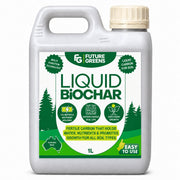
LIQUID BIOCHAR
$69.00 $48.30
Activates soil carbon systems.

Buying mulch is easier when you separate two questions: how deep should this material go, and how much volume will cover your bed?
The shortcut: area in m² × depth in mm = litres of mulch.
For cubic metres, divide that answer by 1,000. For bags, divide the litres by the bag size and round up. When topping up, calculate only the depth you need to add.
Check the mulch supplier’s directions for your material and plants. A fine mulch, coarse bark and compressed straw bale do not necessarily have the same recommended depth or coverage.
For an ordinary garden-bed estimate, ABC Gardening Australia uses 50 mm as a rule of thumb. That is the example depth below, not a universal instruction for every mulch or planting.
Gardening Australia’s depth advice also warns against overly thick layers around plants: water still needs to reach the soil. Do not use a deep path-mulching or no-dig-bed recipe as a guide for covering established plants.
Measure just the area to be mulched, excluding paving and other uncovered spaces. For curves or several separate beds, use our garden-area measuring guide, then add the areas together.
6 m × 2 m = 12 m²
A rectangular garden bed.
50 mm = 0.05 m
The chosen example layer.
12 × 50 = 600 L
Or 12 × 0.05 = 0.6 m³.
The two calculations give the same answer. One cubic metre equals 1,000 litres. Keep the units together: multiplying square metres by metres gives cubic metres; multiplying square metres by millimetres gives litres.
Quick coverage check at 50 mm:
50 L covers 1 m².
100 L covers 2 m².
1 m³ covers 20 m².
These are calculated volumes for an even layer. They are not a product’s guaranteed bag coverage.
Check uneven ground and the existing mulch layer before ordering. If you choose an allowance for unevenness or settling, keep it separate from the calculated volume rather than disguising it as an exact requirement.
Part the mulch and check its depth at several spots with a ruler. Measure the remaining mulch above the soil, not the soil itself. Rake it level before deciding where more is needed.
50 mm, with 30 mm still in place.
Add 20 mm, not another 50 mm.
12 × 20 = 240 L.
That is five 50 L bags, rounded up.
This assumes the old layer is suitable to keep and reasonably even. Calculate bare patches separately. Spread only what is needed; rounding up your bag count is not a reason to bury plants with the remainder.
The Western Metropolitan Regional Council mulch factsheet supports weeding, watering dry soil and leaving stems clear. If water beads on the exposed soil, our water-repellent soil guide explains the next checks. Do not assume another layer of mulch will fix it.
Area: ___ m² × new depth needed: ___ mm = ___ L
Bulk: litres ÷ 1,000 = ___ m³
Loose-fill bags: litres ÷ ___ L per bag = ___ bags, rounded up
Choose a suitable depth, measure what is already there, and buy for the layer you actually need.
Activates soil carbon systems.

Spreads water through loose soils.
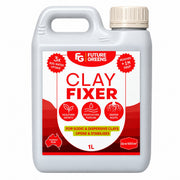
Conditions hard-setting clay.
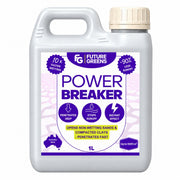
Opens clay and non-wetting sand.
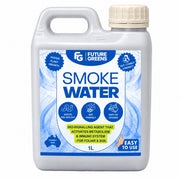
Boosts soil life and plant growth.

Nutrient-loaded granular biochar.
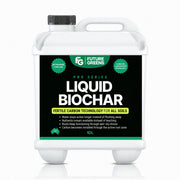
Concentrated root-zone carbon.
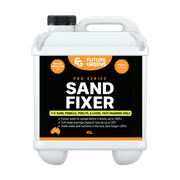
Wider water spread, better efficiency.
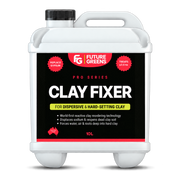
Helps hard-setting clay accept water.
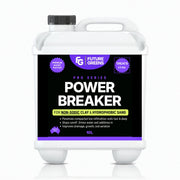
Penetrates clay and non-wetting sand.